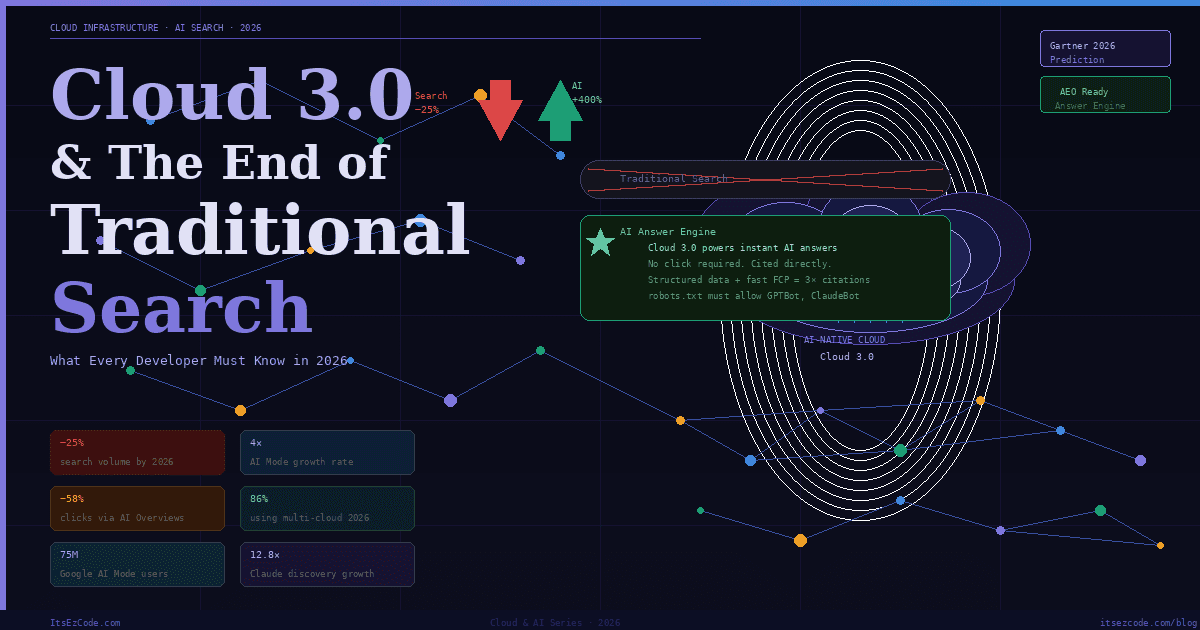
Cloud 3.0 & The End of Traditional Search: What Every Developer Must Know in 2026
Two earthquakes are happening simultaneously in the technology landscape — and most developers are only watching one of them.
The first earthquake is visible: AI is eating search. Gartner predicts traditional search engine volume will drop 25% by 2026 as AI chatbots and virtual agents become the preferred way people find information. AI Overviews now reduce organic clicks by 58%. Google's own AI Mode has hit 75 million users and is growing at 4× the rate of its initial launch. The way your applications get discovered is changing faster than most teams have noticed.
The second earthquake is structural: Cloud is rebuilding itself from the ground up. What analysts are calling Cloud 3.0 isn't an upgrade to existing infrastructure — it's a complete architectural rethink designed around AI workloads rather than traditional applications. In 2026, most new cloud applications will be AI-native by default, designed around models, agents, orchestration layers, and continuous evaluation. The infrastructure your applications run on is being redesigned beneath your feet.
Taken separately, each of these shifts demands a response. Together, they represent the most significant change to how developers build and ship applications since the move to cloud-native architecture a decade ago.
This guide breaks down what both shifts mean in concrete terms for MERN and Next.js developers — and what to do about it.
Part 1: The End of Traditional Search (As We Knew It)
Let's start with the numbers that should be on every developer's radar.
Gartner predicted search engine volume would drop 25% by 2026 due to AI chatbots and virtual agents replacing user queries. That prediction is now arriving early. AI Overviews now reduce organic clicks by 58% — meaning more than half the people who see an AI-generated answer never visit the source page at all. Google's AI Mode usage grew 4× within months of launch. ChatGPT and other AI platforms are increasingly the first destination, not a secondary tool.
⚠️ The Click Collapse Is Real:
AI Overviews reduce clicks by 58% according to Ahrefs data from February 2026. Copilot grew 25.2× and Claude grew 12.8× as discovery platforms in 2025. Traditional SEO strategies — keyword targeting, backlink building, metadata optimization — are necessary but no longer sufficient. Your content needs to be findable by AI systems, not just search crawlers.
This isn't search dying. It's search transforming. Understanding the new structure is the first step to building for it.
The Three-Layer AI Search Landscape
Traditional search had one layer: a ranked list of links. AI search in 2026 has three distinct layers, each with different rules for how content gets surfaced.
Layer 1 — AI Overviews (Google's integrated AI answers) Appear at the top of search results for informational queries. They pull from indexed web content, heavily favor authoritative sources (domains with 32K+ referring domains are 3.5× more likely to be cited), and reduce click-through significantly. Currently highest in Science (43.6% share), Health (43%), and Pets & Animals (36.8%). Lowest in Shopping (3.2%) and Real Estate (5.8%).
Layer 2 — Standalone AI Platforms (ChatGPT, Claude, Perplexity) These systems draw from a wider range of sources than Google, often citing lower-ranking or even non-ranking pages if they provide contextually relevant information. They favor content with high brand mention volume on platforms like Reddit and Quora, review presence on Trustpilot and G2, and fast page load times — pages with FCP under 0.4 seconds average 6.7 citations, versus 2.1 for slower pages.
Layer 3 — Agentic AI (the emerging frontier) AI agents that autonomously browse, read, compare, and synthesize across multiple sources to complete tasks. These agents interact with web content programmatically — meaning structured data, semantic HTML, and machine-readable context matter more than keyword density.
From SEO to AEO: Answer Engine Optimization
The strategic shift developers need to understand is from Search Engine Optimization (helping crawlers rank your page) to Answer Engine Optimization (helping AI systems cite and reference your content).
The rules are different:
Traditional SEO                  Answer Engine Optimization (AEO)
────────────────────────────     ────────────────────────────────
Keyword density                  Factual accuracy + citations
Backlink quantity                 Domain authority + brand mentions
Meta descriptions                Structured data (JSON-LD)
H1/H2 hierarchy                  Semantic HTML + clear answers
Page authority score             Review platform presence
Internal linking                  Machine-readable content structure
Load speed (nice to have)        FCP < 0.4s (3× citation advantage)
For developers building content platforms, blogs, or documentation sites, the practical changes are significant.
Structured data is no longer optional. JSON-LD markup telling AI systems what your content is, who wrote it, when it was published, and what it's about directly affects citation probability.
// app/blog/[slug]/page.tsx — AI-optimized structured data
export default async function BlogPost({ params }) {
  const post = await getPost(params.slug);

  const jsonLd = {
    '@context': 'https://schema.org',
    '@type': 'TechArticle',
    headline: post.title,
    description: post.description,
    author: {
      '@type': 'Person',
      name: post.author,
      url: 'https://itsezcode.com/about',
    },
    publisher: {
      '@type': 'Organization',
      name: 'ItsEzCode',
      url: 'https://itsezcode.com',
    },
    datePublished: post.date,
    dateModified: post.updatedAt ?? post.date,
    mainEntityOfPage: `https://itsezcode.com/blog/${params.slug}`,
    keywords: post.tags.join(', '),
    // Helps AI understand content freshness
    temporalCoverage: '2026',
  };

  return (
    <>
      <script
        type="application/ld+json"
        dangerouslySetInnerHTML={{ __html: JSON.stringify(jsonLd) }}
      />
      <article>{/* post content */}</article>
    </>
  );
}
Page speed is now a citation factor. The 3× citation advantage for pages loading under 0.4 seconds FCP transforms performance from a UX metric to a visibility metric.
// next.config.js — AI-era performance configuration
module.exports = {
  images: {
    formats: ['image/avif', 'image/webp'],
    minimumCacheTTL: 86400,
  },
  experimental: {
    optimizeCss: true,
    optimizePackageImports: [
      'lucide-react', '@radix-ui/react-icons',
    ],
  },
  // Preconnect to critical origins
  async headers() {
    return [
      {
        source: '/(.*)',
        headers: [
          {
            key: 'Link',
            value: [
              '<https://fonts.googleapis.com>; rel=preconnect',
              '<https://fonts.gstatic.com>; rel=preconnect; crossorigin',
            ].join(', '),
          },
        ],
      },
    ];
  },
};
Semantic content structure matters. AI systems parse your HTML to understand what a passage of text is answering. Clear question-and-answer structure, concise factual statements, and explicit citations dramatically improve citation probability.
{/* ✅ AI-citable content structure */}

## What is Cloud 3.0?

Cloud 3.0 is the third generation of cloud computing infrastructure,
designed specifically around AI workloads rather than traditional applications.
Unlike Cloud 1.0 (centralized data centers) and Cloud 2.0 (virtualization
and containers), Cloud 3.0 distributes computing across edge nodes,
specialized AI hardware, and hybrid sovereign architectures.

**Key characteristics:**
- AI-native by default (models, agents, orchestration layers)
- Distributed compute (edge + regional + hyperscale)
- Sovereign and multi-cloud architectures
- Optimized for GPU workloads and real-time inference

{/* ❌ What AI struggles to cite */}

## The Cloud Situation

So things have been changing a lot lately in how cloud works and
there are some interesting developments happening that you might
want to know about if you're building stuff...
💡 The AEO Priority List for Next.js Developers:
1. Add JSON-LD structured data to every blog post and documentation page. 2. Optimize FCP to under 0.4 seconds — this is a citation ranking factor. 3. Build brand presence on Reddit, Quora, and review platforms (Trustpilot, G2). 4. Write in clear Q&A structure with explicit factual statements. 5. Ensure your sitemap and robots.txt explicitly allow AI crawler access (GPTBot, ClaudeBot, PerplexityBot).
Allowing AI Crawlers: The robots.txt Update You Need Today
Many sites are accidentally blocking AI crawlers with overly broad robots.txt rules. Check yours now:
# robots.txt — AI-era configuration

User-agent: *
Allow: /

# Explicitly allow AI platform crawlers
User-agent: GPTBot
Allow: /

User-agent: ClaudeBot
Allow: /

User-agent: PerplexityBot
Allow: /

User-agent: Google-Extended
Allow: /

# Block only what you genuinely don't want indexed
Disallow: /api/
Disallow: /admin/
Disallow: /private/

Sitemap: https://yourdomain.com/sitemap.xml
Part 2: Cloud 3.0 — What It Actually Means for Developers
Cloud 3.0 is not a marketing rebrand of existing cloud services. It represents a genuine architectural shift driven by one overriding reality: AI workloads have fundamentally different infrastructure requirements than traditional web applications.
Cloud 3.0 spreads computing across edge nodes, regional infrastructure, and hyperscale data centers. One of the biggest changes is that platforms are now designed around AI workloads, not just traditional applications. AI requires massive computing power, fast data movement, and specialized hardware, and cloud providers are reshaping their infrastructure to meet those demands.
For organizations, this means powerful AI capabilities are accessible on demand — without building expensive systems themselves.
The Three Defining Characteristics of Cloud 3.0
1. AI-Native Infrastructure
Traditional cloud was built for serving files, running APIs, and storing data. Cloud 3.0 is built for inference, training, embedding generation, and multi-agent coordination. In 2026, most new cloud applications will be AI-native by default, designed around models, agents, orchestration layers, and continuous evaluation. Managed AI and data services are growing materially faster than general-purpose compute.
For Next.js developers, this manifests in how you architect AI features:
// ❌ Cloud 2.0 pattern: bolt AI onto existing architecture
// Single API call, no streaming, no agent coordination
export async function POST(req: Request) {
  const { message } = await req.json();
  const reply = await openai.chat.completions.create({
    model: 'gpt-4o',
    messages: [{ role: 'user', content: message }],
  });
  return Response.json({ reply: reply.choices[0].message.content });
}

// ✅ Cloud 3.0 pattern: AI-native with streaming, routing, fallback
import { streamText } from 'ai';
import { openai } from '@ai-sdk/openai';
import { anthropic } from '@ai-sdk/anthropic';

export async function POST(req: Request) {
  const { message, complexity } = await req.json();

  // Route to appropriate model based on task complexity
  const model = complexity === 'high'
    ? anthropic('claude-sonnet-4-5')   // reasoning-heavy tasks
    : openai('gpt-4o-mini');           // lightweight tasks (90% less energy)

  // Stream response — Cloud 3.0 infrastructure handles edge delivery
  const result = await streamText({
    model,
    messages: [{ role: 'user', content: message }],
    // Automatic fallback if primary model is unavailable
    experimental_telemetry: { isEnabled: true },
  });

  return result.toDataStreamResponse();
}
2. Hybrid, Multi-Cloud, and Sovereign Architectures
Cloud 3.0 introduces a diversified ecosystem of hybrid, multi-cloud, and sovereign architectures to support AI scalability and resilience. This means the single-cloud deployments that defined Cloud 2.0 are giving way to more complex, intentional infrastructure decisions.
86% of organizations are already using a multi-cloud strategy. Data sovereignty concerns are driving more private cloud use, with private cloud revenue growth expected to double year-over-year from approximately 13% to nearly 25%.
For developers, this means deployment configuration becomes a first-class architectural decision — not an afterthought:
// lib/cloud-config.ts — Multi-region, sovereignty-aware routing

export const REGION_CONFIG = {
  // EU users: route to EU sovereign infrastructure
  'eu-*': {
    compute:  'aws:eu-north-1',      // Stockholm — high renewable energy
    database: 'neon:eu-central-1',
    storage:  'r2:EEUR',
    aiModel:  'azure:swedencentral', // EU-sovereign AI inference
  },
  // US users: standard hyperscale
  'us-*': {
    compute:  'vercel:iad1',
    database: 'neon:us-east-1',
    storage:  'r2:WNAM',
    aiModel:  'openai:us-east',
  },
  // APAC: edge-first for latency
  'ap-*': {
    compute:  'vercel:sin1',
    database: 'neon:ap-southeast-1',
    storage:  'r2:APAC',
    aiModel:  'anthropic:us-west-2', // closest available
  },
} as const;

// Route incoming requests to the appropriate regional config
export function getRegionConfig(userRegion: string) {
  const prefix = userRegion.slice(0, 3) + '*';
  return REGION_CONFIG[prefix as keyof typeof REGION_CONFIG]
    ?? REGION_CONFIG['us-*'];
}
3. Hybrid Serverless for Agentic AI
Hybrid serverless strategies will be the go-to for agentic AI in 2026. Traditional serverless functions have strict timeout limits — fine for API responses, unsuitable for AI agents that may need minutes to complete multi-step tasks.
The Cloud 3.0 answer is hybrid serverless: short-lived edge functions for latency-sensitive requests, long-running compute for agent workflows.
// app/api/agent/route.ts — Hybrid serverless AI agent endpoint
import { NextRequest } from 'next/server';

// Short timeout for status checks and streaming initiation
export const runtime = 'edge';
export const maxDuration = 30; // edge: 30s max

export async function POST(req: NextRequest) {
  const { task, sessionId } = await req.json();

  // For simple tasks: handle inline at the edge
  if (task.complexity === 'simple') {
    return handleSimpleTask(task);
  }

  // For complex agent tasks: delegate to long-running compute
  // and return a session ID for polling / streaming
  await fetch(process.env.AGENT_RUNNER_URL!, {
    method: 'POST',
    headers: { 'Content-Type': 'application/json' },
    body: JSON.stringify({ task, sessionId }),
  });

  return Response.json({
    status: 'running',
    sessionId,
    pollUrl: `/api/agent/status/${sessionId}`,
  });
}
// app/api/agent/worker/route.ts — Long-running agent worker
// Deployed as a separate function with extended timeout
export const maxDuration = 300; // 5 minutes for complex agent tasks
export const runtime = 'nodejs'; // Node.js runtime for full capabilities
export async function POST(req: Request) {
const { task, sessionId } = await req.json();
// Multi-step agent execution
const agent = new ResearchAgent({
sessionId,
tools: ['web_search', 'code_execution', 'file_read'],
maxSteps: 15,
onProgress: async (step) => {
// Stream progress updates to client via Redis pub/sub
await redis.publish(`agent:${sessionId}`, JSON.stringify(step));
},
});
const result = await agent.run(task.instruction);
await redis.set(`agent:result:${sessionId}`, JSON.stringify(result), {
ex: 3600, // cache result for 1 hour
});
return Response.json({ status: 'complete', result });
}The MCP Revolution: Why It Matters for Cloud 3.0
In 2026, Model Context Protocol (MCP) will emerge as a foundational layer for AI-enabled software. Rather than relying on fragile prompt engineering and bespoke integrations, MCP provides a consistent way for applications to share structured context, tools, and live data with AI models. This shift will significantly reduce integration complexity and allow AI systems to operate with far greater awareness of enterprise data, permissions, and workflows.
For developers, MCP means your applications can expose capabilities to AI agents in a standardized way — making your platform natively composable in the Cloud 3.0 ecosystem.
// lib/mcp-server.ts — Expose your app's capabilities to AI agents
import { Server } from '@modelcontextprotocol/sdk/server/index.js';
import { StdioServerTransport } from '@modelcontextprotocol/sdk/server/stdio.js';

const server = new Server(
  { name: 'pharmacy-pos-mcp', version: '1.0.0' },
  { capabilities: { tools: {}, resources: {} } }
);

// Expose inventory search as an MCP tool
server.setRequestHandler('tools/call', async (request) => {
  if (request.params.name === 'search_inventory') {
    const { query, saleType } = request.params.arguments;

    const results = await prisma.medicine.findMany({
      where: {
        OR: [
          { name: { contains: query, mode: 'insensitive' } },
          { manufacturer: { contains: query, mode: 'insensitive' } },
        ],
        batches: { some: { quantity: { gt: 0 } } },
      },
      select: {
        id: true, name: true, form: true,
        customerPrice: true, doctorPrice: true,
        discountPercent: true,
        batches: { select: { quantity: true, expiryDate: true } },
      },
      take: 10,
    });

    return {
      content: [{
        type: 'text',
        text: JSON.stringify(results),
      }],
    };
  }
});

// AI agents can now query your inventory natively
// No custom API integration needed — just MCP
The Developer Skill Gap Cloud 3.0 Creates
2026 will be a year of internal IT upskilling on cloud tools. The rise of AI is increasing the need for superior control over data governance, movement, and security. Organizations will likely require increased experience in how to design and manage infrastructure to best enable the control of data.
For MERN and Next.js developers specifically, the Cloud 3.0 skill gap breaks down into four areas:
AI-native architecture — designing applications around agents and models from the start, not bolting AI onto existing systems. Understanding streaming, orchestration layers, and multi-model routing.
Multi-cloud and sovereign deployment — knowing which regions carry renewable energy advantages, which satisfy data sovereignty requirements, and how to route users appropriately based on compliance needs.
Edge compute optimization — understanding the difference between edge runtime and Node.js runtime, when to use each, and how to design for the latency characteristics of distributed compute.
Observability for AI systems — traditional monitoring (uptime, response time, error rate) is insufficient for AI applications. You need token consumption tracking, model routing analytics, agent step monitoring, and quality evaluation pipelines.
// lib/ai-observability.ts — Track what matters in Cloud 3.0 apps
import { trace, context } from '@opentelemetry/api';

export async function trackedAICall<T>(
  operationName: string,
  model: string,
  fn: () => Promise<{ result: T; usage: { promptTokens: number; completionTokens: number } }>
): Promise<T> {
  const tracer = trace.getTracer('ai-operations');
  const span = tracer.startSpan(operationName);

  try {
    const { result, usage } = await fn();

    // Track the metrics that matter for AI operations
    span.setAttributes({
      'ai.model':             model,
      'ai.prompt_tokens':     usage.promptTokens,
      'ai.completion_tokens': usage.completionTokens,
      'ai.total_tokens':      usage.promptTokens + usage.completionTokens,
      'ai.estimated_cost_usd': calculateCost(model, usage),
      'ai.operation':          operationName,
    });

    span.setStatus({ code: 1 }); // OK
    return result;
  } catch (error) {
    span.recordException(error as Error);
    span.setStatus({ code: 2, message: (error as Error).message }); // ERROR
    throw error;
  } finally {
    span.end();
  }
}

function calculateCost(model: string, usage: { promptTokens: number; completionTokens: number }) {
  const rates: Record<string, { input: number; output: number }> = {
    'gpt-4o':             { input: 0.0000025, output: 0.00001 },
    'gpt-4o-mini':        { input: 0.00000015, output: 0.0000006 },
    'claude-sonnet-4-5':  { input: 0.000003, output: 0.000015 },
  };
  const rate = rates[model] ?? { input: 0, output: 0 };
  return (usage.promptTokens * rate.input) + (usage.completionTokens * rate.output);
}
🌐 Your Cloud 3.0 + AEO Action Plan
- Week 1 — Search visibility audit: Check robots.txt allows GPTBot, ClaudeBot, and PerplexityBot. Add JSON-LD structured data to your top 10 blog posts. Measure current FCP and target sub-0.4s.
- Week 2 — Content structure refactor: Rewrite your top posts with explicit Q&A structure and factual, citable statements. Build brand presence on Reddit and review platforms.
- Week 3 — AI-native architecture: Replace single-turn AI calls with streaming endpoints using the Vercel AI SDK. Add model routing (mini for simple, full for complex). Implement basic AI observability.
- Week 4 — Cloud deployment upgrade: Audit your deployment region for renewable energy ratio. Enable Dependabot. Add edge middleware for geographic routing. Review your robots.txt and sitemap.
- Ongoing — MCP integration: Expose your application's core capabilities as MCP tools. As AI agents become primary users of APIs, MCP-native apps become discoverable by default.
What This Means for Your Existing Next.js Application
If you have a live Next.js application today, the Cloud 3.0 and search transition creates a concrete to-do list — not a rebuilding project.
For content discoverability: The single highest-ROI action is adding JSON-LD structured data and optimizing FCP. Both take less than a day and provide immediate improvements in AI citation probability. Checking your robots.txt for unintended AI crawler blocks takes 10 minutes and could be blocking your content from AI discovery entirely.
For architecture: You don't need to rebuild. You need to add the streaming layer, the model router, and the observability hooks. These are additive changes — they don't break existing functionality.
For deployment: Multi-cloud and sovereign architectures matter most for regulated industries and large enterprise products. For smaller applications and developer tools, the immediate priority is ensuring you're deployed to a region with good renewable energy ratios and low latency for your primary users.
Common Pitfalls to Avoid
⚠️ Cloud 3.0 & AEO Mistakes to Avoid:
Treating AI Search as an SEO Problem
The skills overlap — authoritative content, fast pages, good structure — but the mechanics differ fundamentally. AI systems don't just rank pages, they synthesize across them. A page can be cited without ranking. Optimization requires understanding how AI models select and weight sources, not just how Google indexes them.
Single-Cloud Lock-In for AI Workloads
The Cloud 3.0 landscape is more fragmented than Cloud 2.0. Different providers have genuine strengths in different AI workload types. Building hard dependencies on a single provider's proprietary AI services creates costly migration risk as the landscape evolves. Prefer open standards (MCP, OpenTelemetry) and SDK abstractions over direct provider SDK calls where possible.
Ignoring Sovereign Cloud Requirements
If you're building products for European or regulated enterprise customers, data sovereignty is no longer a compliance checkbox — it's a sales requirement. GDPR enforcement has intensified and customers are asking where AI inference happens, not just where data is stored. Factor this into your architecture now rather than retrofitting it later.
No AI Observability Layer
Traditional monitoring tells you your server is up. It doesn't tell you your AI model is hallucinating on 15% of requests, that token costs doubled this week due to a prompt change, or that your agent is hitting dead ends on 30% of tasks. Build observability specifically for AI operations before you scale AI features.
Blocking AI Crawlers Accidentally
Audit your robots.txt now. Many sites have broad "Disallow: /" rules from older bot-blocking strategies that unintentionally block GPTBot, ClaudeBot, and PerplexityBot. In a world where AI platforms are primary discovery channels, being invisible to AI crawlers is the equivalent of being de-indexed from Google in 2015.
The Opportunity Hidden in the Disruption
Every major platform shift in technology has produced the same pattern: those who understand the new rules first build the products that define the next era. The move from desktop to web. From web to mobile. From server-hosted to cloud-native.
Cloud 3.0 and the AI search transition represent a shift of the same magnitude. The signals are clear. In 2026, the competition won't be on the AI models, but on the systems. What matters now is orchestration — combining models, tools, and workflows. The model itself is not going to be the main differentiator.
For MERN and Next.js developers who understand this, the opportunity is significant. The skills that matter — AI-native architecture, multi-model orchestration, semantic content structure, edge-aware deployment — are exactly the skills that the developer community is positioned to develop fastest.
By 2026, search will no longer be primarily text-based. Advances in multimodal models mean users will naturally combine text, voice, images, documents, charts, and video in a single interaction. Search systems will be expected to interpret and reason across these modalities seamlessly.
The applications that succeed in this landscape are the ones being designed today — by developers who are thinking about how AI systems discover, consume, and act on their content, not just how human users navigate it.
That's the real opportunity of Cloud 3.0 and the AI search transition. Not just adapting to the shift — but building the products that define what comes next.
For more practical guides on building AI-native MERN and Next.js applications for the Cloud 3.0 landscape, visit ItsEzCode and explore the complete library.
Further Reading & Tools
- Vercel AI SDK — Production AI for Next.js with streaming and multi-model support
- Model Context Protocol — Open standard for AI agent tool integration
- Google Search Central — AI Overviews — Official guidance on AI Overview optimization
- Schema.org TechArticle — Structured data reference for technical content
- Gartner Search Volume Prediction — Primary research on search volume decline
- OpenTelemetry for AI — Observability standard for AI operations
Last updated: March 2026
The AI search and Cloud 3.0 landscape is evolving weekly — bookmark this guide and check back as new platforms, protocols, and data emerge.

Malik Saqib
I craft short, practical AI & web dev articles. Follow me on LinkedIn.